
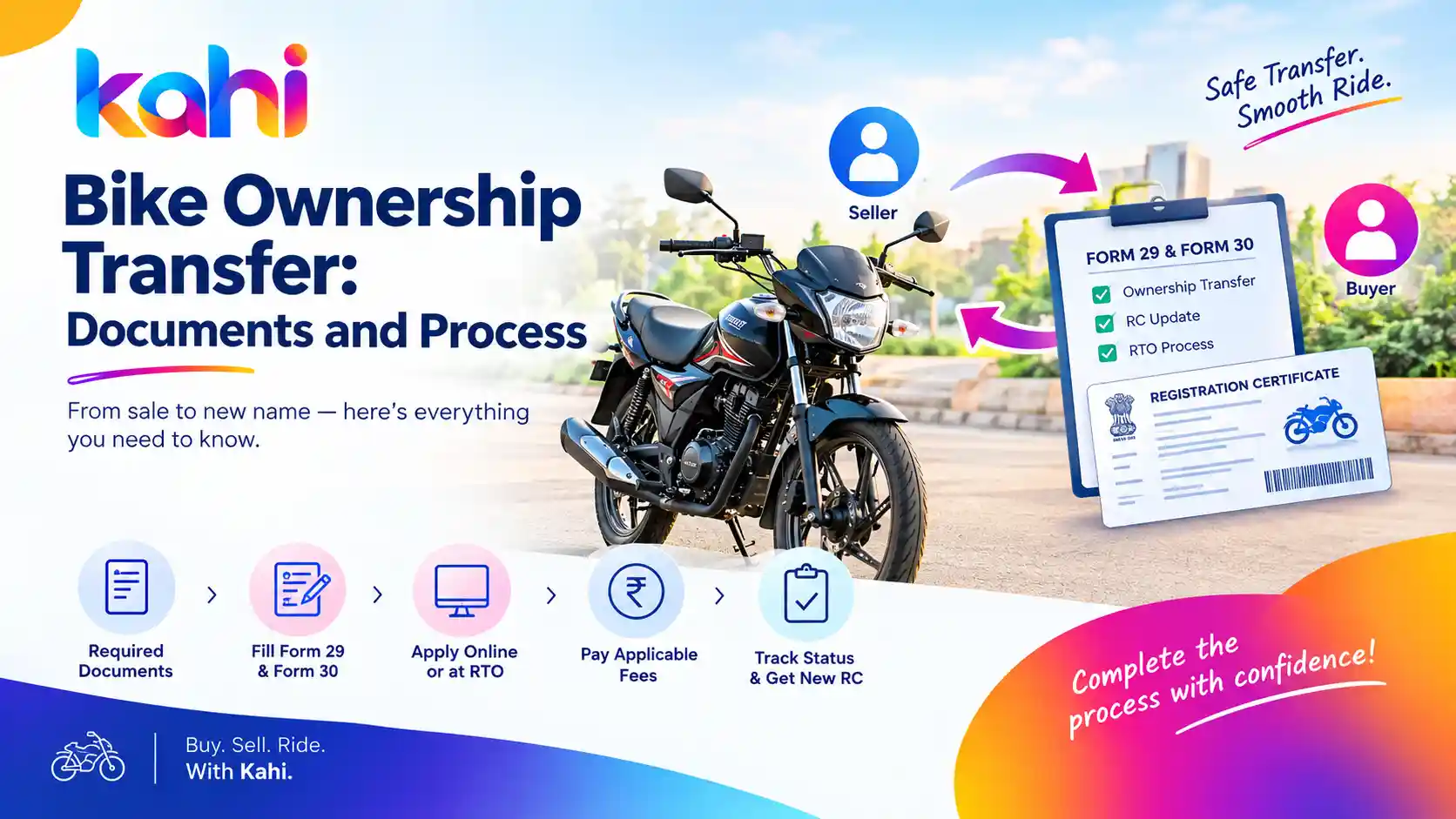
Buying or selling a second-hand bike can be a smart way to save money or earn a fair resale price. However, completing the payment and handing over the keys is not enough. You must also ensure that the bike’s registration certificate (RC) is transferred to the new owner’s name.
Bike ownership transfer is the official process of updating the registered owner’s details with the Regional Transport Office (RTO). Completing this process helps protect both the buyer and seller from future documentation problems, traffic challans and ownership disputes.
In this guide, we explain the documents required for bike ownership transfer in India, the role of Forms 29 and 30, the application process, possible fees and common mistakes to avoid.
What Is Bike Ownership Transfer?
Bike ownership transfer is the process of officially recording a new owner’s name in the vehicle registration records after a sale.
For example, if you purchase a second-hand Honda, Hero, TVS, Bajaj or Royal Enfield motorcycle, you need to apply for an RC transfer so that the vehicle is legally recorded in your name.
The same process applies when you sell your existing bike to another person.
Completing the transfer helps establish a clear ownership record and makes it easier to manage insurance, future resale and other vehicle-related formalities.
Documents Required for Bike Ownership Transfer
Before starting the application, the buyer and seller should prepare the necessary documents. Requirements can vary depending on the state, RTO and circumstances of the transfer.
Essential documents checklist
| Document | Purpose |
|---|---|
| Form 29 | Notice of transfer submitted by the seller |
| Form 30 | Application for transfer of ownership |
| Original Registration Certificate (RC) | Confirms the vehicle’s registration details |
| Valid bike insurance certificate | Provides evidence of insurance |
| Valid Pollution Under Control (PUC) certificate | Confirms applicable emission compliance |
| Identity proof | May be requested for verification |
| Address proof | Helps establish the buyer’s address |
| PAN card or Form 60 | May be required under applicable rules |
| Sale receipt or sale agreement | Records the transaction and handover details |
| Applicable RTO fee | Payment for processing the transfer |
The RTO may request additional documents, photographs, an undertaking or other verification depending on local requirements.
You can access official vehicle registration forms through the Parivahan website.
What are Form 29 and Form 30?
Form 29: Notice of transfer of ownership
The seller uses Form 29 to notify the relevant registering authority that the bike has been sold and delivered to the buyer.
Form 30: Application for transfer of ownership
Form 30 is used to apply for the formal transfer of ownership in the registration records. It contains details relating to the seller, buyer and vehicle.
Both forms are important in a standard sale. Make sure the information is accurate and that the required signatures are completed.
Bike Ownership Transfer Process in India: Step by Step
Follow these steps when buying or selling a second-hand bike.
Step 1: Verify the bike and its documents
Before making payment, check the registration number, chassis number and engine number against the RC.
Also verify the seller’s identity and confirm that the seller is the registered owner or is legally authorised to complete the transaction.
Check the following:
- The RC details match the physical bike.
- Insurance and PUC documents are valid as applicable.
- Any outstanding traffic challans are checked and resolved.
- The bike is not subject to an unresolved loan or ownership dispute.
- The vehicle’s service and accident history are reviewed where possible.
If the bike has an active loan, coordinate with the lender to complete the required loan closure and hypothecation formalities.
Step 2: Complete the sale agreement
Prepare a sale receipt or written agreement that records the transaction.
Include the bike’s registration number, make and model, agreed sale price, date and time of handover, and the names and contact details of both parties.
Keep copies of the signed document and payment proof. These records can help establish when possession was transferred if a dispute arises later.
Step 3: Fill in Form 29 and Form 30
The seller and buyer should complete the relevant ownership transfer forms with the correct details.
Check the registration number, chassis number, names, addresses and signatures carefully. Errors or missing information can delay processing.
Download the official forms from the Parivahan forms page.
Step 4: Apply online or through the RTO
Depending on the state and the services available for your registration, you may be able to begin the application online through the VAHAN vehicle services portal.
The general online process is:
- Open the VAHAN vehicle services portal.
- Enter the bike’s registration number.
- Choose the applicable basic or registration service.
- Select the ownership transfer option.
- Enter the requested vehicle and buyer details.
- Upload documents or complete verification as instructed.
- Pay the fee displayed by the portal.
- Save the application receipt and reference number.
Some applications require an RTO visit, document submission or vehicle verification. Follow the instructions shown for your particular registration.
Step 5: Submit documents and pay the fee
Submit the required documents according to the instructions from the portal or RTO.
The applicable fee depends on the vehicle category and the service being requested. Additional charges may apply in certain cases, such as interstate transfers, delayed applications or related registration formalities.
Always use an official payment channel and keep the receipt.
Step 6: Track the application
Use the application or acknowledgement number to check the transfer status through the relevant official service.
If the application is pending, check whether the RTO requires additional documents, corrected information or an appointment.
Step 7: Confirm the new RC details
After approval, check that the new owner’s details have been updated in the registration records.
The buyer should verify the updated RC information and retain the digital or physical document as applicable. The seller should keep the sale agreement, transfer acknowledgement and other proof of submission.
Do not assume the transfer is complete simply because the application has been submitted.
How Long Does Bike Ownership Transfer Take?
The time required depends on the RTO, completeness of the documents, verification requirements and whether the transfer is within the same state or involves another state.
Under the general central guidance for a normal sale, the buyer’s Form 30 application is to be made within 14 days for a vehicle registered within the same state and within 45 days for a vehicle registered outside the state, with additional requirements for an interstate transfer.
State-specific procedures and instructions may differ, so confirm the applicable deadline with the relevant RTO before applying. Do not delay the paperwork after the sale.
For official guidance, refer to Parivahan’s ownership transfer information.
Bike Ownership Transfer Fees
There is no single all-inclusive price for every bike ownership transfer. The amount depends on the applicable registration fee, state procedures and any additional services required.
Potential costs include:
- Ownership transfer processing fee
- Applicable taxes or other RTO charges
- Interstate NOC or registration-related expenses, where required
- Charges for correcting or replacing documents, if applicable
- Late fees or penalties, if imposed under applicable rules
Check the fee shown on the official portal or confirm it with the relevant RTO before making payment. Avoid relying on an unverified fee estimate from a third party.
What If the Bike Is Registered in Another State?
If you buy a bike registered in another state, additional formalities may apply.
Depending on the circumstances, you may need a No Objection Certificate (NOC) from the original registering authority and may have to complete reassignment of the registration mark or other state-specific procedures.
Before purchasing an interstate bike, confirm:
- Whether an NOC is required
- Whether any outstanding tax or challan needs to be cleared
- Which RTO will process the transfer
- Whether reassignment of the registration mark is necessary
- Which documents and fees apply in the destination state
Interstate transfers can take longer, so confirm the process before finalising the deal.
Important Tips for Bike Sellers
Selling your bike responsibly involves more than receiving payment.
- Submit the ownership transfer notice: Complete the required forms and retain proof of submission.
- Record the handover: Keep a signed sale receipt with the date and time of delivery.
- Keep payment proof: Save the bank transfer receipt or other transaction record.
- Check the application status: Follow up until the transfer is approved.
- Inform your insurer: Contact the insurance company and follow its procedure for transferring the policy.
- Handle FASTag or linked services: If any are associated with the vehicle, close or update them where applicable.
Until the registration records are updated, the seller may continue to face complications related to the vehicle. Keep all transaction documents until the transfer is confirmed.
Important Tips for Bike Buyers
Before paying for a used bike, take these precautions:
- Verify the seller and the original RC.
- Match the chassis and engine numbers.
- Check insurance validity and any outstanding challans.
- Review service history and inspect the bike’s mechanical condition.
- Confirm that any existing loan or hypothecation has been properly resolved.
- Obtain signed sale documents and payment proof.
- Apply for ownership transfer promptly.
- Check that the new RC records your name correctly.
You should also contact the insurer to arrange the appropriate policy transfer or insurance formalities. Do not assume that receiving the keys automatically completes the insurance paperwork.
Common Mistakes to Avoid
1. Delaying the RC transfer
A delay can create avoidable legal and administrative complications for both parties. Submit the required documents within the applicable deadline.
2. Handing over the bike without documentation
Always prepare a written sale record and retain copies of the documents submitted for transfer.
3. Ignoring pending loans
A vehicle with unresolved hypothecation may require lender consent or additional paperwork. Resolve this before completing the sale.
4. Paying without checking the vehicle
Verify the bike’s documents and condition before making the final payment. A low price does not necessarily mean a good deal.
5. Not checking the final transfer status
Submitting an application is only one part of the process. Confirm that the registration records have been updated.
Frequently Asked Questions
1. Which forms are required for bike ownership transfer in India?
For a standard sale, Form 29 is used to notify the transfer and Form 30 is used to apply for ownership transfer. The RTO may require additional documents depending on the case.
2. Can I transfer bike ownership online?
You can initiate the process online through the VAHAN portal where the relevant service is available. Some cases require physical document submission or an RTO visit.
3. How many days are allowed for bike ownership transfer?
General central guidance specifies 14 days for a vehicle registered within the same state and 45 days for one registered outside the state. Check the applicable state and RTO instructions to confirm the deadline for your case.
4. Is a sale agreement necessary when selling a used bike?
A written sale agreement or receipt is a useful record of the transaction, payment and handover. It should be kept alongside the official transfer documents.
5. What happens if the bike’s RC is not transferred?
The old registered owner may continue to face complications involving challans, notices or incidents associated with the vehicle. The buyer may also encounter difficulties with insurance and future resale. Both parties should follow up until the transfer is confirmed.
6. Does bike insurance transfer automatically to the buyer?
Do not rely on automatic transfer alone. The buyer should contact the insurer promptly and complete the required policy transfer or documentation. The applicable procedure and deadlines should be confirmed with the insurer.
7. Is an NOC required for an interstate bike transfer?
An NOC or other documentation from the original registering authority may be required, depending on the circumstances. Confirm the requirements with the relevant RTO before purchasing the bike.
Final Thoughts
Bike ownership transfer is an essential step when buying or selling a second-hand motorcycle in India. Completing Form 29 and Form 30, preparing the required documents, paying the applicable fee and checking the final RC status can help both parties avoid unnecessary complications.
Whether you are purchasing your first used bike or selling your current motorcycle, verify the documents, record the transaction properly and complete the transfer within the applicable deadline.
If you are planning to buy or sell a second-hand bike, explore the listings and related buying and selling resources on Kahi to help you take the next step with confidence.