
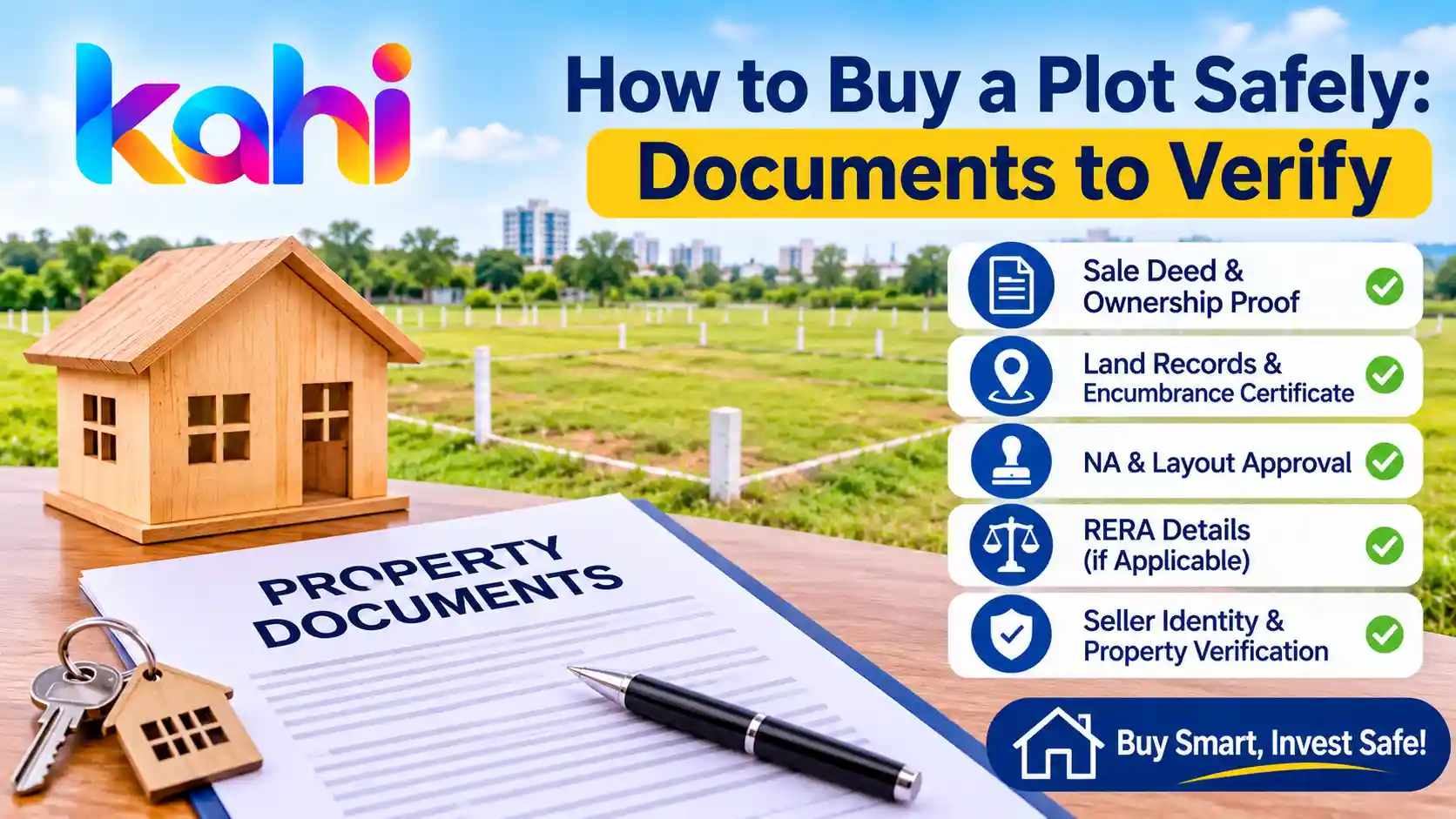
Buying a plot of land in India can be an important step toward building your dream home or making a long-term investment. However, land purchases can also involve ownership disputes, unclear boundaries, unauthorised layouts, hidden loans, and misleading promises.
Before paying a token amount or signing an agreement, it is essential to verify the property documents and confirm that the seller has the legal authority to transfer the land.
This guide explains how to buy a plot safely, which documents to check, and what precautions buyers should take in India.
1. Verify the Sale Deed and Ownership Title
The sale deed is one of the most important documents in a plot purchase. It records the transfer of ownership from the seller to the buyer.
Before proceeding:
- Ask to see the original registered sale deed.
- Check the seller’s name and identification details.
- Match the plot number, survey number, area, and boundaries.
- Confirm that the deed was registered with the appropriate Sub-Registrar.
- Check whether the seller has the legal authority to sell the property.
Do not rely only on a photocopy, brochure, or verbal statement.
Check the Previous Ownership Documents
Ask for earlier sale deeds and other documents showing how the property passed from previous owners to the current seller. This is commonly called the chain of title or ownership history.
A property lawyer may examine a longer ownership period—often around 30 years, depending on the circumstances and local practice—to identify gaps or irregular transfers.
If there are missing documents, unexplained ownership changes, or conflicting details, pause the transaction until the issue is resolved.
2. Obtain an Encumbrance Certificate (EC)
An Encumbrance Certificate (EC) is a record of certain registered transactions involving a property during a specified period.
It can help identify registered transactions such as:
- Sale or transfer deeds
- Registered mortgages
- Certain charges or other registered interests
Request an EC covering an appropriate period from the relevant registration authority or official state portal.
Important: An EC is not a guarantee that the land has no disputes or liabilities. It may not reveal every unregistered claim, litigation, family dispute, or other legal issue. It should be reviewed alongside other documents.
3. Check Land Records and Mutation Entries
Land records help confirm how the property is recorded by the local revenue department.
The document names differ across states. Examples include:
- 7/12 extract (Satbara) in Maharashtra
- Record of Rights (RoR)
- RTC or Pahani in Karnataka
- Jamabandi in some northern states
- Khatauni or Patta in various regions
Check the following details:
- Name of the recorded holder
- Survey or khasra number
- Land area
- Land classification
- Relevant mutation entries
- Other rights, charges, or remarks shown in the record
Mutation records reflect changes in revenue records, but mutation alone does not establish legal ownership. Compare the records with registered deeds and obtain an independent legal title review.
4. Verify Land Use and NA Conversion
Not every plot advertised for residential construction is legally approved for that purpose.
If land was originally agricultural, verify whether the proposed residential or commercial use is permitted and whether any required land-use conversion has been completed.
Depending on the state, this may involve:
- Non-Agricultural (NA) conversion order
- Change of Land Use (CLU) permission
- Zoning or land-use certificate
- Other applicable planning or revenue approvals
Check the land’s classification and permitted use with the relevant revenue or planning authority.
Do not accept a seller’s verbal assurance that conversion or approval “will happen later” without understanding the legal and financial risks.
5. Check the Approved Layout Plan
If you are purchasing a plot in a plotted development, housing scheme, or private layout, verify the approved layout plan.
Confirm:
- The layout has approval from the competent planning authority.
- Your plot number appears in the approved plan.
- The plot dimensions and area match the documents.
- Internal roads and access routes are shown.
- Reserved areas, open spaces, and amenities are accurately represented.
- The approval number and issuing authority can be independently verified.
A marketing brochure or developer-created map is not a substitute for an official sanctioned layout.
6. Verify RERA Registration Where Applicable
The Real Estate (Regulation and Development) Act, 2016 (RERA) applies to certain real estate projects, including qualifying plotted developments.
If the project is required to be registered, check its details on the relevant state RERA website.
Review:
- Project registration number
- Promoter or developer details
- Project location and approved details
- Completion timeline
- Disclosed approvals
- Complaints or regulatory information, where available
RERA registration is useful, but it does not replace title verification, land-use checks, or layout approval. Confirm whether registration is required for the particular project and transaction.
7. Check for Loans, Liens, and Legal Disputes
A plot may have an existing mortgage, charge, or legal dispute.
Ask the seller whether the land has ever been used as collateral for a loan. If it has, obtain appropriate lender documentation, including the loan closure and release documents where applicable.
Your lawyer should also consider checking:
- Relevant court records
- Registered mortgage or charge records
- Land acquisition notifications
- Restrictions on transfer
- Pending disputes involving the seller or property
- Claims by co-owners or legal heirs
If the plot is jointly owned, confirm that all necessary owners or authorised parties are participating in the sale.
8. Verify the Seller’s Identity and Authority
Confirm that the person selling the plot is the legal owner or has valid authority to act on the owner’s behalf.
Check:
- Identity proof
- Name consistency across documents
- Ownership records
- Co-owner consent, where required
- Legal-heir documents, if applicable
- Valid authorisation or power of attorney, if relevant
A power of attorney should be reviewed carefully by a property lawyer. Do not assume that every power of attorney arrangement automatically transfers ownership.
9. Check Property Tax and Other Dues
Ask for available property tax or land revenue receipts and confirm whether dues are outstanding.
Depending on the property and local authority, check:
- Land revenue payments
- Property tax
- Development charges
- Utility or maintenance dues, where applicable
- Other government or local authority charges
Receipts help identify certain payments but do not independently prove clear ownership or legal approval.
10. Visit the Plot and Confirm Its Boundaries
Never purchase land based only on photographs, online listings, or a map shared by the seller.
Visit the plot and verify:
- Exact location
- Survey number and plot number
- Physical boundaries
- Actual area and dimensions
- Access road
- Nearby development
- Signs of encroachment
- Occupation by another person
- Drainage and water availability
- Electricity access and other infrastructure
Where necessary, arrange a survey or demarcation through an appropriate professional or local authority.
Compare the physical plot with the registered documents and approved layout.
11. Be Careful Before Paying Token Money
Before making any advance payment:
- Obtain copies of the key property documents.
- Have an independent property lawyer review them.
- Confirm the seller’s identity and authority.
- Verify the layout and land-use approvals.
- Agree on the token amount and refund conditions in writing.
- Use a traceable payment method.
- Obtain a signed receipt.
- Avoid paying into an unrelated person’s account.
The agreement should clearly state what happens if title verification fails or the seller cannot complete the transaction.
Avoid pressure tactics such as “pay today or lose the plot” when important documents are still missing.
12. Plot Purchase Document Checklist
Use this checklist before finalising your purchase:
| Document or Check | What to Verify |
|---|---|
| Registered sale deed | Seller’s ownership and property details |
| Previous title deeds | Continuity of ownership |
| Encumbrance Certificate | Registered transactions and charges |
| Land records / RoR | Survey number, area, recorded holder |
| Mutation entries | Revenue-record changes |
| NA / land-use conversion | Permission for intended use |
| Approved layout plan | Plot approval, dimensions, access |
| RERA details | Registration where applicable |
| Seller identity proof | Identity and authority to sell |
| Tax receipts | Outstanding dues |
| Court and dispute checks | Potential litigation or restrictions |
| Physical survey | Boundaries, area, and access |
Document names and requirements differ across states. Ask a local property lawyer to confirm which records apply to your particular plot.
Conclusion
Buying a plot safely in India requires careful document verification, legal review, and an on-site inspection. Start with the registered sale deed and ownership history, then check the encumbrance record, land records, land-use permission, layout approval, and applicable RERA details.
Most importantly, do not make a major payment before an independent property lawyer has reviewed the title and relevant approvals.
If you are searching for land or property listings, Kahi.in can help you explore available options. Treat every listing as a starting point and independently verify the documents, seller, and property before making a commitment.
Disclaimer: This article is for general informational purposes only and is not legal advice. Property laws, document names, and approval procedures vary by state and locality. Consult a qualified local property lawyer and relevant authorities before purchasing land.