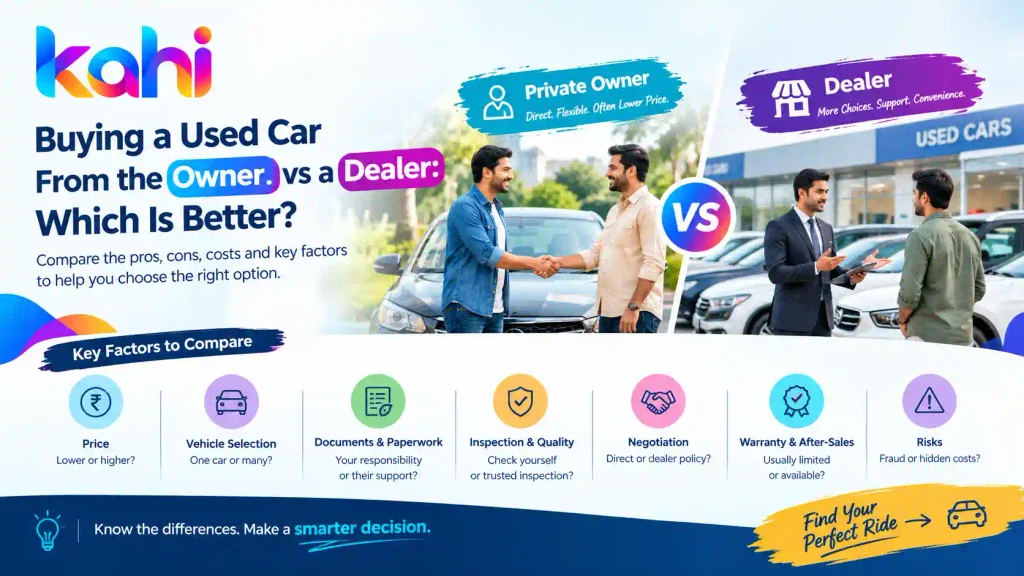
Buying a used car can be a smart way to save money while getting a vehicle that suits your needs. However, one important decision can affect your budget, buying experience, and peace of mind: should you buy a used car directly from the owner or purchase it from a dealer?
Both options have advantages and disadvantages. Buying directly from an owner may help you negotiate a lower price and learn more about the car’s history. A dealer may offer more vehicle choices, assistance with paperwork, and, in some cases, a limited warranty.
In this guide, we compare buying a used car from an owner vs a dealer in India, covering prices, vehicle condition, paperwork, negotiation, and safety tips to help you make the right decision.
1. Buying a Used Car Directly From the Owner
When you buy a used car from its owner, you deal directly with the person who currently owns the vehicle instead of going through a dealership.
Advantages of Buying From an Owner
Potentially lower prices: Private sellers may offer a lower asking price because there is no dealership margin. However, the final price depends on the vehicle’s condition, demand, age, and local market rates.
Better insight into the car’s history: You can ask the owner about driving habits, servicing, repairs, accidents, and the reason for selling. Always verify their answers using service records and an independent inspection.
More room for negotiation: Owners may be willing to negotiate based on your budget, how quickly they want to sell, and the car’s condition.
Direct communication: You can discuss the vehicle’s maintenance, usage, and known issues directly with the person who has driven it.
Disadvantages of Buying From an Owner
- Limited selection: You generally evaluate one vehicle at a time unless you contact multiple sellers.
- More responsibility: You may need to arrange inspections, check documents, negotiate the price, and coordinate the ownership transfer yourself.
- Limited after-sales support: Private sellers usually do not provide dealership-style warranties or service packages.
- Fraud risks: Fake documents, undisclosed loans, ownership disputes, and misleading listings are possible.
Buying from an owner can be a good option if you are comfortable checking a vehicle carefully and handling the purchase process.
2. Buying a Used Car From a Dealer
A used-car dealer purchases vehicles for resale or helps connect buyers with sellers. Dealers may offer cars from different brands, price ranges, and model years.
Advantages of Buying From a Dealer
More cars to compare: Dealers often have several vehicles available, making it easier to compare models, features, and prices in one place.
Help with paperwork: Some dealers assist with registration certificate (RC) transfer, insurance documentation, and other formalities. Confirm exactly what is included before paying.
Possible warranty options: Certain dealers offer limited warranties or certified-used-car programmes. Read the terms carefully, including exclusions, duration, and claim conditions.
Potentially convenient purchase: A dealer may help coordinate test drives, inspections, financing, and documentation.
Disadvantages of Buying From a Dealer
- Higher asking prices: Dealer margins, reconditioning, and other business costs may increase the price.
- Sales pressure: Some sellers may encourage you to make a quick decision.
- Quality varies: Not every dealer provides the same level of inspection, transparency, or customer support.
- Warranty limitations: A warranty may cover only specific parts or faults and may exclude wear-and-tear items.
A dealer can be suitable if you value convenience, want multiple cars to compare, or prefer assistance with the buying process.
3. Owner vs Dealer: Quick Comparison
| Factor | Buying From an Owner | Buying From a Dealer |
|---|---|---|
| Price | May be lower | May be higher |
| Negotiation | Direct negotiation | Depends on dealer policy |
| Vehicle selection | Usually one car per seller | Often several cars |
| Maintenance history | Ask the owner for records | Request available service records |
| Inspection | Arrange an independent inspection | Verify inspection claims independently |
| Warranty | Usually unavailable | May be offered; check terms |
| Paperwork | Buyer and seller coordinate | Dealer may provide assistance |
| Convenience | Requires more personal effort | Can be more convenient |
| Main concern | Verification and fraud prevention | Price transparency and vehicle quality |
Important: Neither option is automatically safer. A well-maintained car sold by a private owner can be a better purchase than a poorly inspected dealer car, and a reputable dealer can offer a smoother experience than an uncooperative private seller.
4. Which Option Is Cheaper?
Buying from an owner can sometimes save money, but the lowest advertised price does not always mean the lowest total cost.
Before making a decision, calculate the full cost of ownership at the time of purchase.
Consider these expenses:
- Final negotiated vehicle price
- Independent mechanic inspection
- Immediate repairs and replacement parts
- Insurance renewal or transfer requirements
- Applicable registration and ownership-transfer charges
- Pending loan or hypothecation-related formalities, if any
- Tyres, battery, and other maintenance needs
For example, suppose a private seller offers a car for ₹4 lakh, while a dealer offers a comparable vehicle for ₹4.25 lakh. If the privately sold car needs ₹40,000 in repairs, the dealer’s car could be the more economical option—provided its condition and documentation are verified.
Always compare similar vehicles with similar age, mileage, service history, and condition.
5. Documents to Check Before Buying a Used Car
Whether you buy from an owner or a dealer, document verification is essential.
Check the following before making the final payment:
- Registration Certificate (RC): Confirm the registered owner’s details and vehicle information.
- Insurance: Verify validity and understand the steps required to transfer or obtain the policy.
- PUC certificate: Check the Pollution Under Control certificate where applicable.
- Service records: Review available maintenance history and repair invoices.
- Loan or hypothecation status: Confirm whether any finance-related entry remains on the RC and complete the required formalities.
- Pending challans: Check for outstanding traffic fines.
- Ownership transfer forms: Confirm the required forms and process with the relevant Regional Transport Office (RTO) or official transport portal.
- Identity and authorisation: Ensure the seller is the registered owner or has valid authority to sell the vehicle.
Never rely only on photocopies or verbal assurances. Verify the information through the appropriate official channels before completing the transaction.
6. How to Inspect a Used Car Before Buying
A professional inspection can help identify problems that are difficult to notice during a short test drive.
Exterior and Body
Look for uneven paint, rust, inconsistent panel gaps, signs of major repairs, and damage around the chassis or body structure.
Engine and Mechanical Condition
Start the car when the engine is cold, listen for unusual noises, check for warning lights, and look for fluid leaks. Have a qualified mechanic assess any concerns.
Tyres, Brakes, and Suspension
Check tyre wear, braking performance, steering behaviour, and unusual sounds when driving over bumps.
Interior and Electronics
Test the air conditioning, infotainment system, lights, windows, seat adjustments, central locking, and other equipment.
Test Drive
Drive the car on different types of roads when possible. Observe acceleration, braking, gear changes, steering, and engine temperature.
Independent Inspection
Even if a dealer claims that a vehicle is certified or inspected, review the inspection report and consider arranging an independent evaluation.
7. Warning Signs to Watch Out For
Be cautious if a seller or dealer:
- Refuses an independent inspection.
- Pressures you to pay a booking amount immediately.
- Offers a price that seems unusually low without a convincing explanation.
- Cannot provide the RC or relevant ownership documents.
- Gives inconsistent information about mileage, accidents, or ownership.
- Requests payment to an unrelated account without a clear, verifiable reason.
- Avoids providing a written receipt or sale agreement.
- Promises a warranty without written terms.
Never share OTPs, banking passwords, or UPI PINs with a seller. Do not pay the full amount until the vehicle, seller, documents, and payment arrangements have been verified.
8. How Kahi Can Help You Explore Used Cars
Finding the right used car starts with comparing suitable options rather than choosing the first vehicle you see.
On Kahi, you can explore a marketplace for buying and selling different types of items, including vehicles, depending on available listings. Compare advertised prices, review seller information, ask relevant questions, and arrange a vehicle inspection before committing to a purchase.
When contacting a seller, ask for the car’s manufacturing year, kilometres driven, ownership history, service records, accident history, insurance status, and reason for selling.
Treat an online listing as the starting point for your checks—not as proof that a vehicle is genuine or in good condition.
9. Owner or Dealer: Which Should You Choose?
Choose a private owner if you want to negotiate directly, are comfortable researching prices, and can arrange document checks and an independent inspection.
Choose a dealer if you want more vehicles to compare, value assistance with paperwork, or find a suitable car with a clearly documented warranty.
In either case, make your decision based on the car’s condition, verified documents, total cost, and the seller’s transparency—not simply the asking price.
Frequently Asked Questions
1. Is buying a used car directly from an owner safe?
It can be safe if you verify the seller’s identity, check the RC and other documents, review the vehicle’s history, arrange an independent inspection, and complete the ownership transfer correctly.
2. Is buying a used car from a dealer more expensive?
It can be, because dealers may include a business margin and reconditioning costs. However, compare the final price, vehicle condition, included services, and any written warranty before deciding.
3. Can I negotiate the price of a used car at a dealership?
Yes. Negotiation depends on the dealer, vehicle demand, condition, service history, and local market prices. Research comparable listings and use inspection findings to support your offer.
4. What documents should I check before buying a second-hand car in India?
Check the RC, insurance, PUC certificate where applicable, service records, loan or hypothecation status, pending challans, and documents required for ownership transfer.
5. Should I get a mechanic to inspect a used car?
Yes. An independent mechanic can identify potential engine, transmission, suspension, accident-repair, and other issues before you make a substantial payment.
6. What is the biggest risk when buying a used car?
Common risks include hidden mechanical damage, inaccurate mileage claims, incomplete ownership documents, undisclosed finance, and payment fraud. Document verification and an independent inspection help reduce these risks.
Final Thoughts
Buying a used car from an owner or a dealer can work well when you know what to check. Private sellers may offer attractive prices and direct communication, while dealers may provide greater choice and additional assistance.
Before paying, compare similar cars, verify all documents, inspect the vehicle independently, and understand every cost involved. A careful buying process can help you find a reliable car that fits your budget.
Explore available listings on Kahi and take the time to verify each vehicle before making your decision.