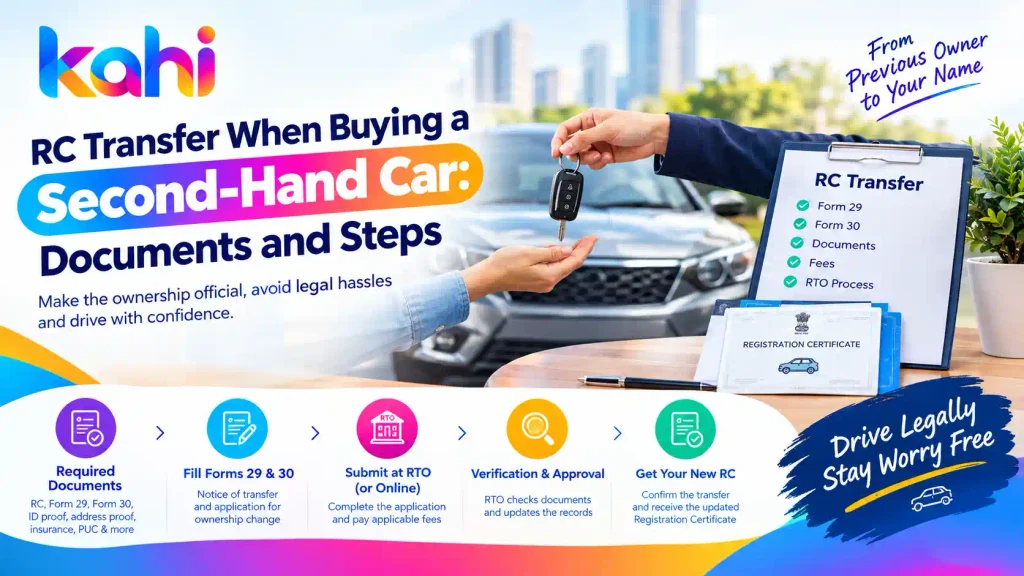
Buying a second-hand car can be a smart way to save money while getting a vehicle that suits your needs. However, completing the payment and taking possession of the car are not the final steps. You must also ensure that the vehicle’s Registration Certificate (RC) is transferred to your name.
An RC transfer officially updates the registered owner’s details in the government vehicle registration records. Without completing this process, the previous owner may continue to appear as the registered owner, which can create complications involving traffic challans, insurance claims, notices and future resale.
If you are planning to buy a used car in India, understanding the RC transfer process, required documents, applicable fees and deadlines can help you avoid unnecessary delays.
In this guide, we explain how to transfer an RC when buying a second-hand car, step by step.
1. What Is RC Transfer?
RC transfer is the process of updating a vehicle’s registration records after ownership changes from the seller to the buyer.
For example, if you purchase a used Maruti Suzuki Swift from another person, the vehicle’s registration records must be updated so that you become the registered owner.
The transfer is handled by the relevant Regional Transport Office (RTO) or through the applicable online vehicle services.
Completing the RC transfer helps establish the correct ownership record and makes it easier to manage future insurance renewals, resale and other vehicle-related formalities.
Important: A signed sale agreement or payment receipt alone does not replace the official RC transfer process.
2. Documents Required for RC Transfer of a Second-Hand Car
Before applying, collect the documents commonly required for a normal used-car ownership transfer.
| Document | Purpose |
|---|---|
| Original Registration Certificate (RC) | Confirms the vehicle’s registration details |
| Form 29 | Notice of transfer of vehicle ownership |
| Form 30 | Application for transfer of ownership |
| Valid motor insurance | Confirms insurance coverage |
| Valid Pollution Under Control (PUC) certificate | Shows applicable emissions compliance |
| Buyer’s address proof | Verifies the new owner’s address |
| Buyer’s identity proof | Helps establish the applicant’s identity |
| PAN card or Form 60, where applicable | Used for applicable identification and tax-related requirements |
| Sale receipt or delivery note | Records the transaction between buyer and seller |
| Applicable transfer fee and tax | Required to process the application |
The RTO may request additional documents, photographs, signatures, vehicle verification or other information depending on the state and circumstances. Check the relevant authority’s current checklist before submitting your application. <Cite refs={[“turn963845search1″,”turn963845search2”]}/>
What are Forms 29 and 30?
Form 29 — Notice of Transfer of Ownership
This form records the seller’s notification that the vehicle has been sold and ownership is being transferred.
Form 30 — Application for Transfer of Ownership
This form is used to apply for the official transfer of ownership in the registration records.
You can find the official forms on the Parivahan website. <Cite refs={[“turn963845search0″,”turn963845search12″,”turn963845search13”]}/>
3. Step-by-Step Process for RC Transfer
Follow these steps when purchasing a second-hand car from an individual seller.
Step 1: Verify the Car and Seller’s Documents
Before paying the full amount, compare the car’s registration number, chassis number and engine number with the available registration documents.
Also check:
- The seller’s identity and ownership details.
- Whether the RC details match the actual vehicle.
- Insurance validity and PUC status.
- Pending traffic challans, where applicable.
- Whether the vehicle has an outstanding loan or hypothecation.
- Whether the car has any known legal or ownership disputes.
You can use the official Parivahan portal to access relevant vehicle services and check the information available for the registration number.
Do not rely only on screenshots or documents supplied by the seller. Verify important details independently.
Step 2: Complete the Sale Documentation
Once you are satisfied with the vehicle, prepare a written sale agreement or sale receipt.
It should ideally include:
- Buyer’s and seller’s details.
- Vehicle registration number.
- Make, model and variant.
- Sale price and payment details.
- Date and time of delivery.
- Odometer reading at handover.
- Details of documents and keys handed over.
- Signatures of both parties.
Keep copies of the payment proof, signed agreement and delivery acknowledgement. These documents can help establish the transaction details if a dispute arises.
Step 3: Fill Out Forms 29 and 30
The seller and buyer should complete the applicable ownership-transfer forms and sign where required.
Check that the registration number, chassis details, names, addresses and other information are accurate. Incorrect information or missing signatures can delay the application.
Retain copies of the signed forms and any acknowledgement provided during submission.
Step 4: Apply Through the Online Portal or RTO
Start with the Parivahan vehicle services portal, where online ownership-transfer services are available for supported registrations.
The general process is:
- Enter the vehicle registration number.
- Select the applicable basic or ownership-transfer service.
- Complete the requested vehicle and applicant details.
- Upload or provide the required documents, where supported.
- Pay the applicable fee if the online service allows it.
- Follow any instructions for document verification or an RTO visit.
Online availability and the exact steps depend on the registering authority. Some cases may require physical document submission or additional verification. <Cite refs={[“turn963845search9″,”turn963845search4”]}/>
Step 5: Pay the Applicable Fees
RC transfer involves government fees and, depending on the case, other applicable charges or taxes.
The amount may depend on the vehicle category, state, registration authority and the type of transfer. Additional requirements may apply to vehicles moving between states or those with outstanding loan-related entries.
Check the amount shown by the official portal or confirmed by the RTO before paying. Keep the receipt as proof of payment.
Step 6: Complete Any Additional Verification
The RTO may review the application, verify documents or request additional information.
If the application is incomplete, correct the identified issues and provide the missing documents. Keep your application number or acknowledgement so you can track the status.
Step 7: Confirm the RC Transfer Is Complete
Do not assume that the RC has been transferred simply because you submitted the application.
Track the application and verify that the registration records reflect the new owner’s details. Keep the updated RC or its officially available digital version for your records.
If the application remains pending, contact the relevant RTO or use the official portal to check the status.
4. How Long Does RC Transfer Take in India?
The timeline depends on the registering authority, the completeness of the application, verification requirements and whether the transfer involves another state.
The submission deadline is also important. Under the general Parivahan guidance for a normal sale, the buyer’s Form 30 application is generally required within 14 days for a vehicle registered within the same state and within 45 days for an inter-state transfer, with additional documentation for the latter. State-specific instructions can differ; for example, Maharashtra’s Transport Department publishes its own guidance for transfers within and across registering authorities. Confirm the deadline applicable to your vehicle and RTO. <Cite refs={[“turn963845search1″,”turn963845search2”]}/>
For a smoother process:
- Submit the forms promptly after the sale.
- Check all signatures and documents before applying.
- Clear issues related to loans, taxes or pending records.
- Respond quickly if the RTO requests additional information.
- Track the application until the updated registration record is available.
5. What If the Car Has an Outstanding Loan?
If the second-hand car was purchased using a loan, the RC may contain a hypothecation entry in favour of the financier.
Before buying, ask the seller whether the loan has been fully repaid and whether the hypothecation entry has been removed from the registration records.
Depending on the circumstances, you may need lender documentation, a no-objection certificate or the applicable forms to remove or update the hypothecation entry. Form 35 is used for termination of a hire-purchase, lease or hypothecation agreement, where applicable.
Do not assume that a seller’s statement that the loan is paid off means the RC record has already been updated. Verify the status and follow the relevant RTO’s requirements. <Cite refs={[“turn963845search0″,”turn963845search11”]}/>
6. What If the Car Is Registered in Another State?
Buying a car registered in another state may involve additional paperwork.
Depending on the circumstances, you may need a No Objection Certificate (NOC) from the original registering authority and Form 28 or other documents required for the inter-state process.
Before completing the purchase, check:
- Whether an NOC is required.
- Whether the vehicle has outstanding taxes or other dues.
- Whether a new registration mark is required in your state.
- Whether the vehicle meets applicable local requirements.
- Which RTO should process the ownership transfer.
The process can differ depending on whether the vehicle is simply changing owners or is also being moved permanently to another state. Confirm the exact requirements with the relevant transport authority before making the payment. <Cite refs={[“turn963845search1″,”turn963845search11”]}/>
7. Do Not Forget to Transfer the Car Insurance
RC transfer and insurance updates are separate matters. Contact the insurer promptly after buying the car and complete the applicable process for transferring the policy into your name.
Provide the required sale and vehicle documents, and check whether the insurer needs additional forms or verification.
Also confirm the policy’s validity, coverage, exclusions and no-claim bonus treatment. Do not assume that the previous owner’s policy details automatically become fully updated just because you have purchased the car.
Ask the insurer to confirm when the policy record reflects your ownership.
8. Common RC Transfer Mistakes to Avoid
A few simple precautions can prevent delays and disputes.
Not submitting the forms promptly: Delays may lead to complications and missed deadlines.
Paying the full amount without checking the documents: Verify ownership and the car’s registration details before finalising the deal.
Ignoring outstanding loans: Unresolved hypothecation can complicate the transfer.
Using incorrect information: Mismatched names, addresses or registration details can delay processing.
Failing to keep payment proof: Retain the sale agreement, receipt and payment records.
Assuming an application is approval: Track the application until the official records are updated.
Ignoring insurance transfer: Contact the insurer and complete the required policy formalities.
Buying a car with unclear ownership: Avoid completing a transaction if the seller cannot establish the right to sell the vehicle.
9. Second-Hand Car Buying Checklist
Before taking delivery of a used car, use this checklist:
- Verify the seller’s identity and ownership.
- Match the registration, chassis and engine details.
- Inspect the vehicle and review its service history.
- Check insurance validity and PUC status.
- Check for pending challans and outstanding dues.
- Confirm loan or hypothecation status.
- Sign a sale agreement and retain payment proof.
- Complete Forms 29 and 30 as applicable.
- Submit the RC transfer application promptly.
- Complete the insurance transfer process.
- Track the application until the RC record is updated.
10. Buy or Sell a Used Car with More Confidence on Kahi
Buying a second-hand car can offer good value, but checking the vehicle’s condition and completing the ownership-transfer process are essential parts of the transaction.
Take time to inspect the car, verify the documents, agree on the sale terms and follow the applicable RTO process. Do not skip legal or registration checks just to complete the deal quickly.
Visit Kahi to explore vehicle listings and take the next step towards finding a used car that fits your needs and budget.
Frequently Asked Questions (FAQs)
1. Which documents are required for RC transfer of a second-hand car?
Common documents include Form 29, Form 30, the RC, valid insurance, PUC certificate, buyer’s identity and address proof, and applicable fee payment. Additional documents may be required by the RTO or for special circumstances.
2. Can I transfer RC online in India?
Online ownership-transfer services are available through the Parivahan vehicle services portal for supported registrations. Some cases may require physical documents, verification or an RTO visit.
3. Who is responsible for RC transfer, the buyer or seller?
Both parties have responsibilities. The seller generally provides notice of the sale, while the buyer applies for the transfer of ownership. Both should complete the required forms and retain proof of submission.
4. How much does RC transfer cost?
The cost varies by state, vehicle category and type of transfer. Additional fees or taxes may apply in particular cases. Check the current fee shown by the official portal or confirm it with the relevant RTO.
5. Can I drive the car before the RC transfer is complete?
Possession of the car does not mean the ownership record has been updated. Ensure that the vehicle has the required valid documents and insurance, follow applicable legal requirements and complete the ownership-transfer process promptly. Keep your sale documents and application acknowledgement, but do not treat them as a replacement for the updated RC.
6. What happens if the RC transfer is delayed?
The previous owner may continue to appear in the registration records, potentially causing complications with notices, challans, insurance matters or resale. Follow up with the RTO, resolve any application deficiencies and keep the sale and submission records.
7. Is Form 28 required for every used-car purchase?
No. Form 28 is associated with an NOC in relevant cases, particularly certain inter-state transfers. Requirements depend on the vehicle’s registration and the applicable transport authority.
8. Do I need to transfer the insurance after buying a used car?
Yes, you should contact the insurer promptly and complete the required policy-transfer formalities. Confirm that the insurer has updated the policy records and that coverage remains appropriate.
Conclusion
RC transfer is an essential step when buying a second-hand car in India. By checking the vehicle’s documents, completing Forms 29 and 30, submitting the application correctly and confirming the updated registration record, you can reduce the risk of avoidable delays.
Remember to check the requirements and deadlines published by your relevant RTO, especially if the vehicle is registered in another state or has an outstanding loan.
Before finalising your next used-car purchase, make document verification and RC transfer part of your buying checklist. Explore used-car options on Kahi and make your purchase with greater confidence.